
Buying an air purifier becomes much more urgent the moment Singapore starts smelling smoky. Unfortunately, that is also when every purifier suddenly seems to promise the same thing. There are HEPA filters, “medical-grade” filters, ions, UV lights, formaldehyde removal, app-controlled sensors and room-coverage figures large enough to suggest one little machine can somehow purify an entire HDB flat from the corner of the living room.
The most useful number is usually much less exciting: CADR, or Clean Air Delivery Rate.
Singapore’s National Environment Agency specifically recommends looking at CADR when choosing a portable air cleaner for haze, because it tells you how much clean air the machine can actually deliver. NEA also says the purifier needs to be appropriately sized for the room rather than chosen solely by filtration claims.
That distinction changes our recommendations considerably.
For most Singapore homes, we think the Xiaomi Smart Air Purifier 4 Pro offers the strongest combination of airflow, filtration, smart controls and price.
Philips is the better premium choice if quiet operation matters. Sharp’s new Purefit is particularly interesting for households specifically worried about haze and pets, while Dyson’s HushJet makes more sense in a bedroom than its much larger and more expensive purifiers.
Here are the models we would actually shortlist in 2026.
About This Guide
We compared air purifiers currently available in Singapore based primarily on:
- published CADR or clean-air performance
- room suitability
- particle filtration
- activated-carbon filtration
- noise
- filter replacement frequency
- current Singapore pricing
- smart controls and air-quality sensors
- local availability of replacement filters
- whether the price makes sense for what the purifier actually delivers
We have deliberately not treated every manufacturer coverage claim as directly comparable.
Different brands calculate “room coverage” using different numbers of air changes per hour and different testing standards. A machine claiming to cover 100m² once per hour is not necessarily more useful for haze than another claiming 50m² at a much higher air-change rate.
For haze, we place much more weight on airflow and particle filtration.
NEA says smoke CADR is the most relevant CADR measurement for haze pollutants. Where brands only publish general particle CADR rather than an AHAM smoke CADR, we state that rather than pretending all CADR figures were measured identically.
Prices in this guide were checked in October 2026 and can change during sales.
Who Is This Guide For?
This guide is for Singapore households comparing an air purifier for:
- haze and PM2.5
- everyday dust
- pollen and airborne allergens
- pet dander
- cooking smells
- bedrooms
- children’s rooms
- HDB living rooms
- larger open-plan homes
It is not a medical-device ranking, and an air purifier is not a treatment for asthma, allergies or other health conditions.
The purpose here is simpler: which machines do the best job of moving indoor air through an effective filter at a sensible price?
Key Takeaways
Best air purifier overall: Xiaomi Smart Air Purifier 4 Pro
Best premium all-rounder: Philips PureProtect 3200 Series
Best specifically for haze and pets: Sharp Purefit FX-S82E
Best smart mid-range alternative: Levoit Core 400S
Best quiet premium bedroom purifier: Dyson HushJet Purifier Compact HJ10
Best cheap purifier for a bedroom: Xiaomi Smart Air Purifier 4 Compact
Best for very large spaces: Novita A8i
If you live in a typical HDB flat and want one purifier for a bedroom or living room, we would start with Xiaomi, Philips or Levoit rather than immediately spending four figures.
Best Air Purifiers in Singapore at a Glance
| Air Purifier | Best For | Published Performance | Price* |
|---|---|---|---|
| Xiaomi Smart Air Purifier 4 Pro | Best overall | 500m³/h particle CADR; 35–60m² effective coverage | About S$369 |
| Philips PureProtect 3200 | Premium all-rounder | 520m³/h particle CADR; HEPA + activated carbon | About S$555 |
| Sharp Purefit FX-S82E | Haze and pets | 480m³/h CADR; recommended up to 62m² | About S$699 |
| Levoit Core 400S | Smart mid-range option | Approx. 400m³/h published CADR; HEPA + carbon | About S$299 |
| Dyson HushJet HJ10 | Quiet bedrooms | 99.97% filtration at 0.3µm; 24dB Sleep Mode | S$499 |
| Xiaomi Smart Air Purifier 4 Compact | Small bedrooms | 230m³/h particle CADR; 16–27m² effective coverage | S$129 |
| Novita A8i | Very large spaces | 847.1m³/h AHAM smoke CADR | S$1,898 |
What's your pick?
Vote for the place you would recommend most.
0 readers voted
*Indicative Singapore prices checked in October 2026. Promotions change frequently.
1. Xiaomi Smart Air Purifier 4 Pro

Best for: Most Singapore homes
Published particle CADR: 500m³/h
Effective coverage: 35–60m²
Filtration: Primary filter, high-efficiency particle filter and activated carbon
Night mode: 33.7dB
Official listed price: Around S$369
The Xiaomi Smart Air Purifier 4 Pro is the purifier we would recommend first to most people.
It is not the cheapest purifier on the list, nor does it make the grandest filtration claims. What it does have is an unusually strong combination of 500m³/h particle CADR, sensible dimensions, proper particle sensing and a price that remains well below most premium machines.
Xiaomi rates it for an effective area of 35 to 60m².
That makes it a good match for many HDB living rooms and bedrooms, while the 360-degree intake means you have slightly more flexibility about placement than with purifiers that need one intake side facing into the room.
The purifier monitors both PM2.5 and PM10, displays readings on its OLED screen and automatically changes speed when air quality deteriorates.
You can also control it through the Xiaomi Home app.
Its filter combines a primary layer, Xiaomi’s electrostatic high-efficiency particle media and activated carbon. Xiaomi says the media removes 99.97% of 0.3-micron particles and recommends replacement roughly every six to 12 months depending on use and pollution.
One distinction worth understanding is that Xiaomi does not describe this filter as a conventional HEPA filter. It uses mechanical filtration combined with an electrostatic charge to achieve its stated efficiency.
For most households, that would not stop us buying it. We care more about demonstrated particle removal and airflow than whether a particular acronym is printed on the box.
Editor’s Verdict
The Xiaomi 4 Pro is our overall recommendation because it gets the basics right without charging a premium for them.
The 500m³/h particle CADR gives it considerably more cleaning headroom than many small purifiers, and it remains compact enough that putting one in the living room does not feel like adding another piece of furniture.
The app and sensor are useful, but neither is why we rank it first.
The reason is much less glamorous: it moves a lot of air through an efficient filter for the money.
If haze is the reason you are buying a purifier today, this is the first model we would compare.
2. Philips PureProtect 3200 Series AC3220

Best for: Families wanting strong performance with quieter operation
Published particle CADR: 520m³/h
Filtration: HEPA NanoProtect + activated carbon
Noise: As low as 15dB
Maximum power: 36W
Current price: Around S$555; suggested retail price S$699
Philips’ PureProtect 3200 is one of the strongest all-round alternatives to Xiaomi if you are willing to spend more.
Its headline specification is a 520m³/h particle CADR, slightly above the Xiaomi 4 Pro, combined with a three-stage system using a pre-filter, HEPA NanoProtect filtration and activated carbon. Philips says the unit filters 99.97% of particles at 0.003 microns from air passing through the filter.
More interesting for everyday use is how quiet it is.
Philips says the purifier can operate at 15dB at its quietest setting and reaches only 47.5dB at maximum. Maximum power consumption is 36W.
That combination makes it attractive if the purifier will run throughout the night or sit close to a living area where fan noise gets irritating.
The Air+ app adds scheduling, remote control and automatic modes, while onboard sensors track PM2.5 and allergens.
Philips recommends replacing its filter roughly once a year, although actual lifespan varies according to pollution and use.
Editor’s Verdict
Philips is the one we would choose over Xiaomi when noise and refinement matter enough to justify another few hundred dollars.
Its current sale price around S$555 is not unreasonable given the 520m³/h airflow, low noise and two-year warranty.
The main thing we would ignore is the headline claim that it covers up to 135m².
That room-size number comes from the manufacturer’s calculation method and should not be interpreted as meaning one Philips purifier will aggressively clean the air across an entire 5-room HDB flat.
Buy it for the 520m³/h clean-air performance, not the giant coverage number.
3. Sharp Purefit FX-S82E
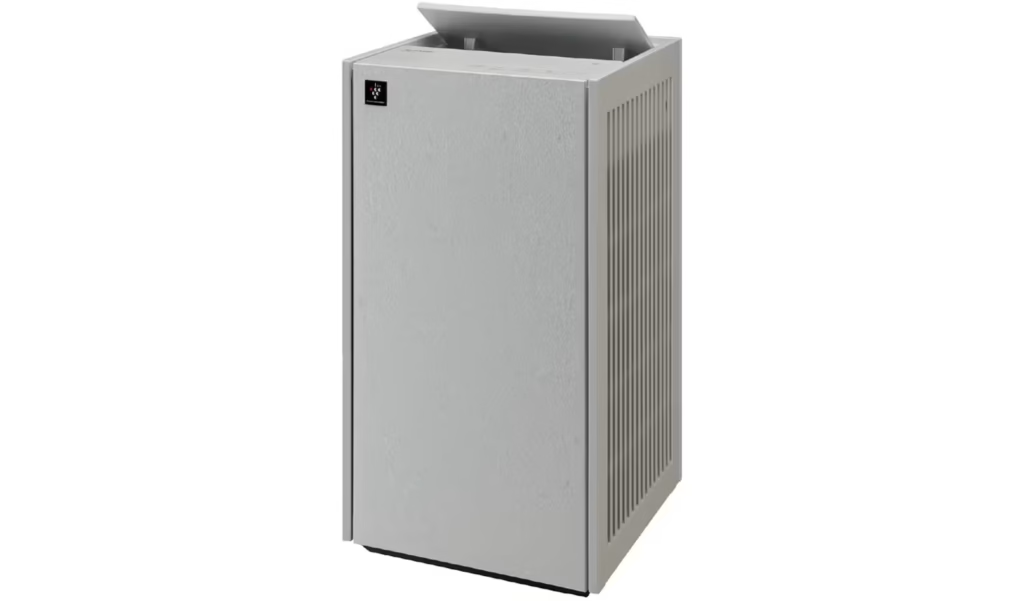
Best for: Haze season, pet households and people who want a dedicated haze setting
Published CADR: 480m³/h
Recommended area: Up to 62m²
Filtration: Dual pre-filters, dust filters and deodorisation filters
Filter life: Up to two years
Current price: About S$699
Sharp launched the Purefit FX-S82E in Singapore in September 2026, which makes it the newest model in this guide.
What immediately caught our attention was not its design award or Plasmacluster branding.
It was the very Singapore-specific Haze Mode.
Sharp says the setting increases air collection when outdoor air quality deteriorates, while the purifier’s dual-sided intake and triple-filtration arrangement deliver a published CADR of 480m³/h across a recommended area up to 62m².
There is also a Pet Mode and six environmental sensors.
The unit is designed to sit relatively close to a wall rather than needing enormous clearance on every side, which is more useful in a Singapore flat than manufacturers sometimes realise.
Sharp also advertises filter life of up to two years.
At around S$699, however, it is substantially more expensive than the Xiaomi 4 Pro despite having similar raw airflow.
Editor’s Verdict
Purefit is our specialist haze pick rather than our value pick.
We like the Haze Mode, wall-friendly design and longer stated filter life, particularly for households that also have pets.
What we would not do is spend the extra money purely because the machine says “Haze” on the app.
The Xiaomi and Philips already move large quantities of air through efficient particle filters, which is fundamentally what you need during smoke haze.
Sharp becomes more compelling when you value the extra sensors, pet mode, design and potentially longer maintenance interval too.
4. Levoit Core 400S

Best for: A well-priced smart purifier from a dedicated air-care brand
Published CADR: Around 400m³/h on Levoit’s Singapore product page
Filtration: Three-stage filter with HEPA and activated carbon
Smart control: VeSync app
Current price: Around S$299
Replacement filter: From about S$79.90
The Core 400S sits in the useful middle ground between inexpensive bedroom purifiers and premium S$500-plus machines.
Levoit’s Singapore store currently sells it for around S$299 and describes a three-stage system with HEPA filtration and activated carbon, app control and an air-quality sensor.
The purifier is particularly easy to recommend if you already use smart-home routines.
VeSync lets you control settings remotely, while the onboard PM2.5 sensor can run the machine automatically according to air conditions.
Replacement filters currently start at about S$79.90 through the Singapore distributor.
There is one specification issue worth knowing about.
Levoit’s own Singapore materials are not completely consistent about the Core 400S CADR, with different local pages displaying figures around 400 to 433m³/h.
We would therefore treat it as a roughly 400m³/h-class machine rather than pretending one precise figure is beyond dispute.
Editor’s Verdict
The Core 400S is probably the strongest alternative to Xiaomi for somebody who wants to stay around S$300.
Xiaomi gives you more published airflow for similar money.
Levoit counters with a particularly established air-purifier ecosystem, readily available replacement filters and a straightforward smart interface.
We would happily use either.
If haze is your main concern, compare the final price of the purifier plus one replacement filter, because a cheap machine becomes less impressive if replacement filters are difficult or expensive six months later.
5. Dyson HushJet Purifier Compact HJ10

Best for: Bedrooms where silence and compact size matter
Particle filtration: 99.97% at 0.3 microns
Sleep mode: 24dB
Power consumption: 19W
Particle-filter life: Up to five years under Dyson’s test conditions
Price: S$499
Dyson’s new HushJet is much easier for us to recommend than some of its older purifier-fan combinations.
It is smaller, significantly quieter and costs S$499 rather than well over S$1,000.
In Sleep Mode, Dyson says the machine runs at just 24dB, while typical power use is only 19W.
The filtration system is fully sealed and uses an electrostatic particle filter plus a separate activated-carbon filter. Dyson claims 99.97% filtration of particles down to 0.3 microns.
The electrostatic particle filter is designed to last up to five years based on Dyson’s testing at 12 hours per day, although the activated-carbon filter should still be replaced approximately annually.
That difference matters when comparing running costs.
One frustration is that Dyson does not put a conventional CADR figure front and centre on its Singapore consumer page, which makes direct airflow comparisons with Xiaomi or Philips harder.
Dyson says the HushJet can purify rooms up to 100m², but its footnote indicates this is based on one air change per hour. That is a very different performance target from sizing a machine for rapid particulate reduction during haze.
Editor’s Verdict
We would buy the HushJet for a bedroom, not because it supposedly covers 100m².
At S$499, it is expensive compared with Xiaomi but not absurdly so.
The 24dB Sleep Mode, compact footprint, low power consumption and unusually long particle-filter replacement interval are all genuinely useful bedroom features.
For a living room during severe haze, we would rather have a machine with a clearly published high CADR.
For someone who wants a purifier beside the bed every night of the year, Dyson’s proposition becomes much stronger.
6. Xiaomi Smart Air Purifier 4 Compact

Best for: Small bedrooms, studies and anyone who wants to spend as little as possible
Particle CADR: 230m³/h
Effective coverage: 16–27m²
Sleep mode: 20dB
Power: 27W
Price: S$129
You do not need to spend S$500 to purify a bedroom.
Xiaomi’s 4 Compact currently costs just S$129 through the brand’s Singapore range and provides a published particle CADR of 230m³/h. Its effective coverage is rated at 16 to 27m².
That is enough for many HDB bedrooms.
It also drops to 20dB in Sleep Mode and uses only 27W at maximum.
The filter follows the same general Xiaomi approach as its bigger models, using a primary filter, electrostatic high-efficiency particle media and activated carbon. Xiaomi specifies 99.97% filtration of 0.3-micron particles through the filter media.
You still get Xiaomi Home connectivity, so going cheap does not mean losing scheduling and basic automation.
Editor’s Verdict
This is probably all the air purifier many Singapore bedrooms need.
We would not use it as the only purifier for a large open-plan living and dining room during haze.
But putting a S$129 Compact in each bedroom may actually be more useful than buying one enormous machine and hoping clean air somehow travels through closed bedroom doors.
For parents looking for a purifier specifically for a child’s bedroom, this is where we would start before moving into much more expensive “nursery” products.
7. Novita A8i

Best for: Large open-plan homes, clinics, offices and people who prioritise very high smoke CADR
AHAM smoke CADR: 847.1m³/h
PM2.5 CADR: 1,142m³/h
Filtration: H13 HEPA, activated carbon and additional filtration stages
Price: S$1,898
The Novita A8i is expensive enough that we would not recommend it to the average HDB household.
Its performance figures, however, are difficult to ignore.
Novita publishes an AHAM AC-1 smoke CADR of 847.1m³/h, along with a PM2.5 CADR of 1,142m³/h.
That smoke figure is particularly useful because NEA specifically says smoke CADR is the most relevant CADR measurement when choosing a purifier for haze.
The A8i also appears on NEA’s published portable-air-cleaner reference list with a reported overall smoke CADR of 847m³/h.
Filtration includes a washable pre-filter, activated carbon and H13 HEPA media, alongside additional components.
There is also an ionisation system. NEA advises consumers to treat electronic air-cleaning technologies separately from mechanical filtration when sizing purifiers and to pay attention to relevant safety data, so we would base our buying decision primarily on the A8i’s mechanical filtration and smoke CADR rather than the ionisation claims.
The cost is considerable: the purifier is currently S$1,898 and the two-year replacement-filter pack is S$358.
Editor’s Verdict
The Novita A8i is overkill for most bedrooms and extremely interesting for genuinely large spaces.
This is the machine we would look at for a big open-plan landed home, childcare facility, clinic or office where buying several smaller units is inconvenient.
Its biggest advantage is not an inflated “up to 2,790 sq ft” marketing figure.
It is the 847.1m³/h AHAM smoke CADR, which gives us a far more useful basis for comparing actual haze performance.
For a normal HDB bedroom, save the money.
For a large open area where clean-air volume really matters, the Novita finally starts making sense.
Which Air Purifier Is Best for Haze in Singapore?
For most homes, we would choose the Xiaomi Smart Air Purifier 4 Pro.
Its 500m³/h particle CADR is strong enough for typical living rooms, the price is reasonable and replacement filters are easy to obtain.
If you specifically want a purifier with a haze-focused operating mode, the Sharp Purefit FX-S82E is the more interesting choice.
For very large spaces where the highest verifiable smoke-airflow figure matters, the Novita A8i stands out because its AHAM smoke CADR is published and also appears in NEA’s portable-air-cleaner reference material.
Does an Air Purifier Actually Help With Haze?
Yes, if it is properly sized and used in an enclosed room.
NEA says portable air cleaners can help keep particulate levels lower in enclosed spaces during smoke haze and recommends using CADR alongside room size when choosing one.
An air purifier does not clean the outdoor air and it does not stop new particles entering every time you leave doors and windows open.
Its job is to repeatedly circulate indoor air through a particle filter.
The faster it can do that relative to the size of the room, the more useful it becomes.
What Is CADR?
CADR stands for Clean Air Delivery Rate.
In simple terms, it measures how quickly a purifier can deliver cleaned air.
A purifier with a highly efficient filter but a tiny fan can be less useful than a machine with strong filtration and much higher airflow.
NEA recommends using smoke CADR when assessing a purifier for haze because the smoke test covers fine particles in a size range relevant to smoke pollution.
The complication is that consumer brands do not all publish the same kind of CADR.
Some quote particle CADR under China’s GB/T testing standard. Some publish AHAM smoke CADR. Others barely publish CADR at all.
That is why you should avoid comparing the numbers as though every laboratory test were identical.
How Much CADR Do You Need?
A useful rule is to think in terms of your room volume, not simply floor area.
NEA’s technical guidance for portable filtration recommends a minimum smoke CADR of approximately:
Room volume × 5
for five air changes per hour in relevant enclosed settings.
Suppose your bedroom is:
15m² × 2.6m high = 39m³
Multiply that by five:
39 × 5 = 195m³/h
A purifier capable of roughly 200m³/h of suitable clean-air delivery therefore gives you a useful starting point.
For a 30m² living room with a 2.6m ceiling:
30 × 2.6 × 5 = 390m³/h
That is why something in the Xiaomi 4 Pro, Philips 3200 or Levoit Core 400S class makes considerably more sense for a living room than a tiny desktop purifier.
Why Manufacturer Room-Coverage Claims Are Confusing
Because manufacturers do not all assume the same number of air changes.
A purifier can claim enormous coverage if it only promises to clean that entire volume of air once or twice per hour.
Xiaomi’s effective coverage figures are calculated differently from Philips’ maximum room-size claims, while Dyson’s 100m² HushJet figure is based on one air change per hour.
None of those claims is necessarily false.
They simply answer different questions.
For haze, we would rather buy a purifier with enough capacity to clean a smaller room several times an hour than congratulate ourselves on owning a machine that technically “covers” the whole flat very slowly.
Do You Need a HEPA Filter?
For fine particles, HEPA filtration remains an excellent default. NEA says highly efficient filters such as HEPA are preferred for removing fine particles.
However, we would not automatically reject every purifier that does not use traditional glass-fibre HEPA media.
Xiaomi, for example, uses electrostatic high-efficiency filter media and publishes a 99.97% filtration efficiency at 0.3 microns.
The more important questions are:
- How efficiently does the filter remove particles?
- How much air can the purifier push through it?
- Is the performance independently tested?
- Can you actually buy replacement filters?
A “HEPA” sticker on a tiny low-airflow purifier does not make it powerful.
H13 vs H14 HEPA: Do You Need H14 at Home?
Usually, no.
H14 media has a higher single-pass filtration efficiency than H13, but that does not automatically make a complete H14 purifier better at cleaning your room.
A very restrictive filter paired with low airflow can deliver less clean air overall than a well-designed H13 system with much greater airflow.
For normal home haze use, CADR and appropriate sizing matter more than chasing the highest HEPA number on the box.
Should You Buy One Large Air Purifier or Several Small Ones?
In many Singapore homes, several purifiers make more sense.
Air does not magically circulate evenly through a flat when bedroom doors are closed.
If you want clean air while sleeping, a purifier in the living room may have limited impact inside the bedroom.
One Xiaomi 4 Pro in the living area plus a smaller Xiaomi Compact in the bedroom can therefore be a more practical setup than placing one enormous purifier at the opposite end of the flat.
Where Should You Put an Air Purifier?
Put it in the room where you spend the most time.
During haze, that will often mean the bedroom overnight and living room during the day.
Do not wedge the purifier tightly between furniture if it relies on side or rear air intake.
Give the intake and outlet enough clearance for air to circulate according to the manufacturer’s instructions.
If the purifier uses 360-degree intake, placing it somewhere reasonably open generally works better than hiding it behind the sofa.
Should You Close Your Windows When Using an Air Purifier During Haze?
When outdoor haze levels are elevated and your aim is to reduce indoor particulate pollution, keeping unnecessary outdoor air infiltration down makes the purifier’s job much easier.
An air purifier cannot keep a room clean efficiently if new smoky outdoor air is continuously entering through wide-open windows.
That does not mean permanently sealing the home regardless of indoor conditions.
Ventilation still matters, particularly outside haze periods. NEA notes that air cleaning does not replace appropriate ventilation more generally.
Does Air-Conditioning Remove Haze?
A normal split-unit air-conditioner should not be treated as a substitute for a proper air purifier.
Its main job is cooling and recirculating indoor air.
The basic filters inside many household air-conditioners are intended primarily to protect the unit and catch larger dust, not provide high-efficiency PM2.5 filtration comparable to a dedicated purifier.
During haze, using air-conditioning with the windows closed can make the indoor environment more comfortable, while an appropriately sized purifier handles fine-particle filtration.
Should an Air Purifier Run All Day?
It can.
Air purifiers generally work best by continually cycling air rather than being switched on only after you can smell smoke.
Auto mode is useful because the machine can reduce its fan speed when particle levels fall and increase it again when necessary.
During a haze episode, we would run the purifier continuously in the rooms being used rather than expecting a 20-minute burst to keep the room clean for the next six hours.
How Often Should You Replace the Filter?
It depends heavily on the model and how polluted the environment is.
Xiaomi generally estimates six to 12 months for its filters.
Philips recommends approximately one year for the PureProtect 3200.
Sharp advertises up to two years for the Purefit’s filters.
Dyson’s HushJet particle filter is designed for up to five years under its specified test conditions, although its activated-carbon filter should be changed around once a year.
Those are guidelines, not guarantees.
Heavy haze, pets, renovation dust and continuous operation can shorten filter life.
Do Air Purifiers Remove Smells?
Particle filters alone are not particularly good at gases and odours.
For cooking smells, pet odours and VOCs, look for a purifier that also contains a meaningful amount of activated carbon or another gas-adsorption medium.
Xiaomi, Philips, Levoit, Sharp and Dyson all combine particle filtration with some form of carbon or deodorisation filtration in the models covered here.
If odour removal is your primary goal, carbon capacity becomes much more important than simply comparing HEPA grades.
What About Ionisers and Plasmacluster?
Some air purifiers supplement mechanical filtration with ionisation or other electronic air-cleaning technologies.
NEA notes that electronic technologies need to be evaluated separately and can potentially produce ozone or other by-products, depending on design. Consumers are advised to request relevant safety data where appropriate.
For that reason, we do not give extra ranking points simply because a purifier generates ions.
Our hierarchy is much simpler:
Good filter + strong airflow first. Extra technology second.
Is a S$1,000 Air Purifier Better Than a S$200 One?
Not automatically.
An expensive purifier may offer:
- quieter motors
- better construction
- bigger filters
- more activated carbon
- better sensors
- longer warranties
- stronger airflow
- unusual gas filtration
- nicer design
But price itself does not clean the room.
For most HDB bedrooms, a S$129 Xiaomi Compact can be entirely adequate.
For a typical living room, a S$299 to S$555 purifier with roughly 400 to 520m³/h of published particle clean-air delivery is already very capable.
The four-figure machines make most sense once the room becomes genuinely large or you need specialised filtration.
Frequently Asked Questions About Air Purifiers in Singapore
What is the best air purifier in Singapore?
Our overall pick is the Xiaomi Smart Air Purifier 4 Pro.
It combines 500m³/h particle CADR, 35 to 60m² effective coverage, PM2.5/PM10 sensing, activated-carbon filtration and smart controls at a much lower price than most premium competitors.
What is the best air purifier for haze in Singapore?
For most households, we would use the Xiaomi 4 Pro.
Sharp’s new Purefit FX-S82E is particularly interesting if you specifically want a dedicated Haze Mode.
For very large spaces, Novita’s A8i has the strongest independently useful smoke-CADR figure among the models in this guide.
What is the best affordable air purifier in Singapore?
For a small room, the Xiaomi Smart Air Purifier 4 Compact at S$129 is our value pick.
For a living room, spend more on the Xiaomi 4 Pro or Levoit Core 400S because their higher airflow is much better suited to larger spaces.
What is the best air purifier for an HDB living room?
The Xiaomi Smart Air Purifier 4 Pro, Philips PureProtect 3200 and Levoit Core 400S are the three we would compare first.
The correct model depends primarily on the size of your actual living and dining space.
What is the best air purifier for a bedroom?
For pure value, Xiaomi’s 4 Compact.
For quieter premium operation, the Dyson HushJet is particularly good, running at a claimed 24dB in Sleep Mode.
What is the best air purifier for a baby’s room?
We would prioritise appropriate room sizing, quiet operation, mechanical particle filtration and easy replacement-filter availability.
The Xiaomi 4 Compact is a strong affordable option for a small nursery, while Philips’ PureProtect 3200 makes sense if you want more cleaning capacity and particularly quiet operation.
Avoid placing the purifier so that strong airflow blows directly towards the cot.
What is the best air purifier for pets?
Sharp’s new Purefit deserves particular attention because it includes a dedicated Pet Mode, while Xiaomi, Philips, Levoit and Dyson all combine particle filtration with activated-carbon or deodorisation filters for dander and odours.
Does an air purifier reduce PM2.5?
A properly sized particle-filtering air purifier can reduce airborne particulate matter including PM2.5 in an enclosed space.
NEA specifically recommends highly efficient filters and appropriate CADR when choosing portable air cleaners for fine particles and haze.
Should I buy an air purifier only when there is haze?
Probably not.
Haze makes the benefit more obvious, but a purifier can also continuously filter everyday dust, pollen, airborne particles and pet dander.
What we would not do is leave the purchase until every air purifier in Singapore is suddenly sold out because the PSI crossed 100.
Is Dyson worth it for air purification?
Sometimes.
We would not buy Dyson purely for maximum clean air per dollar.
The HushJet becomes worthwhile if its 24dB sleep operation, compact design, low power use and long-lasting electrostatic particle filter matter to you.
For raw value, Xiaomi wins.
Which air purifier has the highest CADR in this guide?
The Novita A8i has the highest published figure, including an AHAM smoke CADR of 847.1m³/h.
That does not mean every household should buy it.
A smaller appropriately sized purifier is much cheaper and perfectly adequate for a normal bedroom.
Final Verdict
For most people searching for the best air purifier in Singapore, we would buy the Xiaomi Smart Air Purifier 4 Pro.
It is powerful enough for typical Singapore living spaces, easy to automate, has readily available replacement filters and does not ask you to spend S$700 simply to get respectable clean-air delivery.
The Philips PureProtect 3200 is our preferred step-up option. Its 520m³/h particle CADR and particularly quiet operation make the extra cost easier to justify than a lot of premium air-purifier features.
Sharp’s Purefit is the most interesting new option in 2026, especially during haze season. The dedicated Haze Mode is useful, although its S$699 price means we would want to value the pet features, sensors and longer filter life too.
The Levoit Core 400S sits comfortably in the middle of the market and remains one of the easiest Xiaomi alternatives to recommend.
For bedrooms, the decision becomes simpler. Buy the Xiaomi 4 Compact if value matters, or the Dyson HushJet if quiet operation and design matter enough to spend more.
The Novita A8i belongs in another category. Its extremely high smoke CADR makes sense in large open spaces, but it is unnecessary for the average bedroom or HDB living room.
Most importantly, ignore the temptation to buy based on the biggest room-coverage number printed on the box.
For Singapore haze, the question that matters is much more practical:
How quickly can this machine move the air in my actual room through an effective particle filter?
Answer that first, and choosing an air purifier becomes considerably easier.
Did we miss somewhere?
Singapore changes quickly. Tell our editors about a business you think deserves to be considered for this guide.


